
In the previous article of the Transforming the School Narrative series we explored the importance and power of beliefs and how they could support or hinder learning. The beliefs we focused on mostly related to those belonging to teachers and students but the discussion could equally relate to school leaders as well as parents.
In this article we dig a little deeper into how integrity and ethical leadership is part of the solution to shifting or even creating new narratives in a school.
An ethical dilemma
As part of an upcoming workshop I have been interviewing school principals and assistant principals to gather examples of ethical dilemmas that they have faced during their careers. I have realised from this process how often school leaders face ethical dilemmas just in the course of their day to day job. Here is one scenario:
Teacher X teaches a range of classes at the school and produces great results with the students. Teacher X loves teaching, the students and works well in getting the best out of them. This is a boon to the school as it is currently in the process of turning around from being a “failing” school.
Teacher X previously was a leading teacher at the school and lost the role due to dropping student numbers and a re-structure at the school. This all occurred prior to the current principal being appointed. The current principal finds that, at times, Teacher X can be outspoken and manipulative towards others. He also has had some concerns about Teacher X’s mental well-being.
Recently Teacher X(‘s) behaviour was considered inappropriate in certain interactions with staff members and those staff members approached the Principal with both a complaint and concern for Teacher X’s well-being.
What would you do?
It is an extraordinarily curly dilemma and there is no easy answer. Depending on how the principal and school leadership team handles the situation it could have a disastrous or positive impact on the school culture. However if we view the situation from another perspective – the values and integrity established within the school culture will decide the actions taken and the impact of the result.
Integrity and Values
If the individuals are clear about what they value, what is important to them, and what their vision for their lives (and work) is then they tend to have a lot of clarity in what actions they will or won’t take and also what to base their decisions on. Similarly if the people within a school are clear about the school values, what is important to the community, and what their vision for school is then you will find that there is a lot more clarity about making decisions and more alignment around what is appropriate or inappropriate behaviour.
However, like all organisations, schools are microcosms of society. If we are honest about it unless a school has specifically gone to work on ensuring that the people and school systems are aligned with the school’s values and vision then a lot of murkiness and greyness will exist. And it is in this murkiness that integrity issues arise. I imagine that if we surveyed students, teachers, parents, and school leaders we could come up with an extensive list of areas of murkiness. However some examples of murkiness that could occur in schools include;
- The teacher who, in public, is “working towards” enacting the required instructional approach but continues to do what they have always done when they close their classroom door
- A staff member who uses attendance at an after-school event as justification for coming late the following day (without asking first)
- Favouritism in the treatment given to one group of staff over another
- The pushing of certain students to do unscored Year 12 so that the school results look better
- Talking the talk but not walking the talk with regards to the school values
The definition of integrity I like to use is “the state of being whole and undivided”. I prefer this representation of integrity rather than “the quality of being honest and having strong moral principles” as morality tends to be associated with good/bad, right/wrong and that dichotomy is based on a deficit mindset. Using the definition of integrity as wholeness we can consider what is missing or what are the gaps. This leads to much more positive outcomes for everyone.
The importance of integrity
Why is integrity to the school values and vision so important to the notion of transforming the narrative? Simply put, lack of integrity makes causing change (or even transformation) that much harder. It is like having a boat filled with holes. It is hard to keep afloat if there are many ways for water to enter. It is interesting to watch how elite sporting teams have gone to work on this dimension in the past few years. What we are starting to see is that rather than the sporting club hierarchy dealing with inappropriate behaviour the individual’s team mates are dealing with it. A community that can deal with behaviour that is inconsistent with the agreed upon values and vision will always outperform one that can’t.
Two short articles worth reading around this topic are Who You Are Is How You Lead by Jesse Sostrin and Why integrity is the foundation of a peak performance leader by Chris McGoff.
Resolution
Returning to the ethical dilemma posed at the start, I asked the Principal how he ended up responding. He shared that he values being open and honest, as well as being clear and reasonable. He has a strong vision for himself and the school which is shared by the people he works with using this as a basis for his decision-making. What I found most revealing about the conversation the Principal and I had was how the community responded throughout. The teachers who had made the complaints were pre-dominantly concerned for the well-being of Teacher X. The Principal based his decision on his own and the school values and got expert advice. Teacher X acted professionally in exploring what was at the source of their behaviour. I am clear that this is why this school is actually finding success in shifting the perception of staff, students and parents.
Some Questions to think about
- What behaviours do you see are currently inconsistent with the school’s values and vision?
- What structures and processes are currently inconsistent with the school’s values and vision?
- What could be put in place to align the school and staff to be more consistent with the school values and vision?
Is your school’s culture one in which curiosity and learning from mistakes thrives?
 This article is Part III of the Transforming the School Narrative series. In Part I we explored the default narrative we found across a range of schools in conversations we had with teachers and leaders. Hattie in recent times has been pointing to this too and suggested a reboot of schools. We suggested that the reboot could begin with transforming the narrative for leadership within a school.
In Part II we looked at aspects of Daniel Goleman’s around Emotional and Social Intelligence. The intent was for look deeper into what would leadership teams need to explore and manage to create a narrative within the school that empowers learning and leadership. Goleman pointed to the importance of various leadership styles inherent to creating an environment for optimal performance for teachers and students.
In this article we will explore the question – how does student curiosity influence learning and school structures within a school?
Curiosity
“Curiosity has been hailed as the major impetus behind cognitive development, education, and scientific discovery (Loewenstein, 1994). It is the drive that brings learners to knowledge. Curiosity is about being aware and open, checking things out, experimenting, and interacting within one’s surroundings. In a classroom grounded in curiosity, teachers have the unique opportunity of being able to mine students’ deepest held wonder, making their attention natural and effortless, and allowing them to fully engage. Creating the conditions for curiosity in the classroom will allow us to achieve more authentic motivation from both teachers and students, leading to deeper learning.”
Wendy L. Ostroff
Wendy Ostroff in her recent ASCD book, Cultivating Curiosity in K-12 Classrooms, suggested that curiosity may be critical to student (and teacher) success in school. In her introduction she pointed to research that showed:
- Curiosity jump-starts and sustains intrinsic motivation, allowing deep learning to happen with ease
- Curiosity releases dopamine, which not only brings pleasure but also improves observation and memory
- Curious people exhibit enhanced cognitive skills
- Students’ and teachers’ curiosity can be combined to co-create a curiosity classroom.
If curiosity has so many benefits to learning then you would think that it would be part of every school environment – wouldn’t it?
Barriers to encouraging curiosity
We asked this of teachers at a number of primary schools and many indicted that there were many barriers to encouraging and supporting curiosity. We also encouraged them to come up with potential solutions or actions to enable curiosity to thrive in their classrooms.
| Challenges – what gets in the way of curiosity | Potential Solutions and Actions |
|
|
Encouraging a Culture of Curiosity and Learning
It was interesting to see that the teachers addressed not only their own personal pedagogical and planning development but systemic issues including reporting, parental perceptions, timetables and professional learning. Whilst writers and researchers such as Wendy Ostroff and Kath Murdoch address the pedagogical aspects of developing a culture of curiosity and inquiry it is critical for school leaders to resolve the systemic issues in partnership with teachers. If the systemic issues are not addressed then the learning that occurs within a school will never reach its potential. It is only through aligning the school systems, processes and culture to a powerful school vision that would result in learning and leadership for all.
Some Questions for you to think about
- What are the barriers in your school to fostering a climate of curiosity and learning from mistakes?
- In what ways must teachers take risks in order to foster curiosity?
- In what ways can a classroom be structured so that the teachers are curious and learning themselves?
- In what ways the school systems and processes be redesigned so that the a culture of curiosity thrives?
Are you developing the social intelligence of your leaders and teachers as an access to improving school performance?
In Part I we indicated that our focus this year is on providing the practicalities of creating an empowering narrative for learning and leadership within your school. In this article we explore some of Daniel Goleman’s research behind emotional and social intelligence and what it indicates about shifting the narrative.
Always Learning
I love learning. Last September I had the opportunity to attend one day of the ACEL Educational Leadership Conference in Melbourne. Originally it was purely to support my colleague (Cathryn Stephens) in her presentation on the day but it turned out to be a fabulous insightful learning experience for me. The keynote talks I saw by Daniel Goleman on Focus and Emotional Intelligence in Education and Ben Walden on Inspirational Leadership: Lessons from Henry V were stunning. One for the insights it gave me on a topic I have been building my interest and understanding in and the other for the sheer brilliance and quality of the presenter. Click on the links to experience part of the presentations for yourself.
Emotional Hijack
In his talk Daniel began by highlighting the importance of managing both the cognitive culture AND the emotional culture within a school. A lot of attention is paid to the cognitive culture with a variety of structures and measures but very little to the emotional culture. He points out that managing the emotional culture – motivation, communication, inspiration, etc – can have extraordinary rewards in how well teachers can teach and students can learn.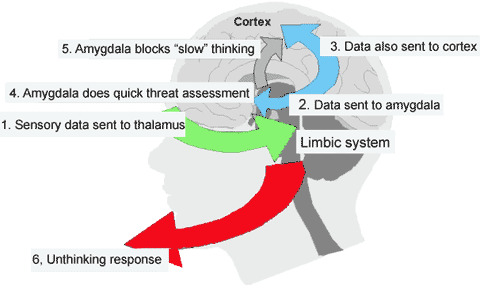
The brain has not had an upgrade in over 100,000 years and it is designed for survival. Whilst our cognitive – rational – learning aspects stem from our pre-frontal cortex the brain is design (via the amygdala) so that emotional elements can hijack the pre-frontal cortex (which developed much later as we evolved). Some examples in schools which trigger emotional hijacks and “fixate our attention on what we perceive is threatening us” include:
- Budget cuts to the school
- Misbehaving or disengaged students in class
- Lack of control over decisions
- Overwhelm
The amygdala has a hair trigger response (“better safe than sorry”) and results in an over-emotional response that often you regret later.
Optimal Cognitive Efficiency
This feature of the brain is not all bad news. Daniel pointed out though that there is a sweet spot where individuals can operate at the maximum cognitive efficiency.
The more apathy and boredom or conversely angst and anxiousness we feel the worse we do cognitively. When challenges pique our interest our motivation increases and our attention focuses. Peak performance occurs when our belief about our ability matches the task’s difficulty and the demand on us. This is a great insight for teachers and students. The best teachers get their students to be in this optimal state as do the best leaders with their staff.
Leadership and Social Intelligence
How leaders lead and create the pre-dominant narrative and learning and leadership in the school matters to achieving optimal performance. Daniel shared that the human brain is peppered with mirror neurons which pick up what another is doing, feeling, etc. This feature of the brain allows emotions to flow between people instantly and allows for rapport (non-verbal synchronicity or a flow state) between people. We are still essentially social creatures. Daniel pointed out that leaders are senders of emotion and can direct transmissions to others.
Daniel defined a model of the four crucial competencies required be effective as leaders in managing the emotional state. You can read more about it here or see more on this video. What interested me most with Daniel’s argument was what he indicated about the impact of leadership style on the climate within a school.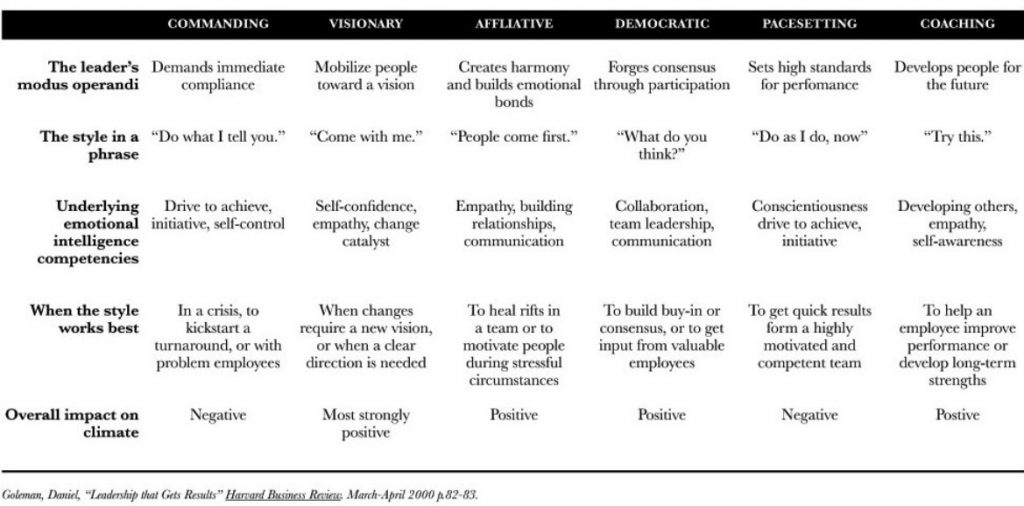
A leader who is visionary and creates a climate of coaching and development has an enormously positive impact on the climate within a school and will lead to the higher performance. In fact, Daniel pointed out that leaders who exhibit 4 or more of the above styles have schools who produce outstanding results. If leaders only exhibit 1 or 2 then students don’t perform.
Implications
If the goal is to create an empowering narrative for learning and leadership then schools need to go to work on changing the “inner algorithms” by which people operate and also the global system (culture) within which they operate. Addressing the global culture is important because our brains can have system blindness. Our perceptions and beliefs are – be default – tuned to the very localized and micro systems (thus the rise of opinions over evidence).
At the level of individuals distinguishing the current leadership styles (or “inner algorithms” for leadership) being used within the school is the first step. The next step is to align the thinking, planning and actions of school leaders (and then teachers) so they exhibit the four most positive leadership styles. Whilst the development of individuals is occurring it is important to explore how the systems and processes within the school are limiting leadership and optimal cognitive performance.
This is the heart of our middle leadership program that we have been offering to schools. We not only distinguish the current perceptions about leadership but lead participants through a process of strategic visionary thinking and planning that sets up a developmental structure for leaders and teachers.
Some Questions for you to think about
- What leadership style(s) would each member of the senior and middle leadership team identify they use?
- What about the teachers in their classrooms and with each other?
- How could you go about developing the structures and systems so that a visionary and coaching leadership style is the pre-dominant approach used in your school?
Is your school’s narrative leading to the practices, structures and the results you want?
The Research on What Works
By now we have no doubt that you and your school’s practices would have influenced by John Hattie’s synthesis and analysis of what works (and what doesn’t) in educational research. His intent was solely to provide some basis for teachers, schools and educational systems to compare the actual research evidence on learning.
 Figure 1: Top Variables as of September 2016
Whether one agrees with the “rankings”, the value of the “effect size” or not, they do give an indication of the relative effect that an approach is likely to have on student learning. You’ll notice that most of these variables in the table above are teacher-driven – which reflects the significant impact we know that teachers have on student learning experiences and outcomes.
Yet where are teachers currently driving learning? What could be influencing the embedding of great evidence based practice?
The Current Narrative
As part of workshops we ran throughout 2016 we spent quite a bit of time with teachers and school leaders unpacking the current perceived status or narratives within their schools. It is a nice exercise which can be quite revealing as it draws out the pre-dominant conversations within the school.
There were two clear narrative trends we noticed across most schools:
- A perceived lack of strategic thinking and planning across the school
- A perceived lack of clear communication and leadership across the school
Think about what this may be like for a moment. You are a teacher who is – day in and day out – interacting with a wide variety of students of varying capacity with the goal of supporting them to grow and progress in their learning and understanding. You try to improve your teaching each day and you occasionally go to external professional learning sessions and are lucky to embed one good idea you learnt from them. You don’t get the time you feel you need to interact professionally with your colleagues and often the meetings you do have devolve into administrivia and sometimes people disagreeing with one another. Curriculum days, if you have them, are either at the end of the year, start of the year or spent doing things that are not linked to curriculum but covering required well-being or other aspects (e.g. anaphylaxis, first aid, etc). The school leadership is working on embedding evidence based practice within the school but it is mostly a top down approach and the goal posts seem to be always moving depending on the latest “research”. The last time you really developed your capacity to be an effective teacher in a rigorous manner was when you were working on your teaching degree or when you did your Masters.
It is not surprising that the impact of these pre-dominant narratives often resulted in teachers and middle leaders feeling disenchanted, overworked and at the effect of constant change and initiatives. Furthermore, the systems within the school – those structures / practices / policies that create the work-ability within the school – are designed to keep the current paradigm in place. The result is glacial improvement or consistent mediocrity since the system is working against improvement.
Transforming the Narrative
Improvement or transformation comes with shifting the narrative within the school and aligning the school vision, systems, practices, processes and policies to achieve the common goals.
- It requires harnessing the school community to “all be rowing in the same direction” and making the goals and progress towards them explicit and visible (rather than owned by a few)
- It requires long term strategic thinking and planning and distributed leadership.
- It requires a shift in who people believe is responsible for learning and leadership within the school.
- It requires clear and constant communication and sharing
This is not easy and takes significant time but it has become more important as schools exist in a constantly changing societal and technological landscape. Hattie, in a recent presentation Shifting away from distractions to improve Australia’s schools: Time for a Reboot, suggest schools reboot themselves. We agree. If you re-look at the highest effect size data in the table above you will notice that they are pointing directly to the importance of teachers developing a shared common understanding and working together for a common goal.
This year many of our newsletters, articles, and workshops will be focused on what we see are the practicalities of rebooting your school and creating a narrative within the school that empowers learning and leadership. Our aim is to provide new contexts, new thinking and practical examples so you begin the journey of creating the school culture you have always wanted.
Some Questions for you to think about
- What are the current narratives or perceptions of teachers, middle leaders and students within the school?
- What do they say are the causes of these perceptions / narratives within the school?
- What is the future you would like to see for learning / school culture?
It is always pleasing to know when a difference has been made. Although it is rare to find out the effects of working with schools and teachers over a long period of time we recently discovered that an article had been written in a major Victorian newspaper about two schools we have been working with.
How one school ditched drugs and violence to become a ‘grammar school’

- Critical friend coaching of senior leadership team
- Action-research coaching of middle leaders
- Partnering them in the development of their strategic plan
- Growing Middle Leadership and Aspiring Leadership sessions
- Facilitating a range of curriculum planning and pedagogy initiatives including their path into Positive Psychology
- Curriculum day presentations
- Critical friend coaching of senior leadership team
- Action-research coaching of middle leaders
- Partnering them in the development of their strategic plan
- Growing Middle Leadership sessions
The first three steps (Step 1, Step 2, and Step 3) of planning as a middle leader has been to set up the context for action. Without having a strong transformational context for leading your team within the school it is quite easy for action to devolve into just doing.
- By articulating a team vision the whole team has a context within which they are acting. They aren’t taking the action because senior leadership or the government has imposed it on them. The actions they will be taking are to fulfil on their vision for the future. This statement answers the question, “Why are we doing this?”
- By making the effort to create a Case for Action narrative the middle leader and team have identified where they are now against their vision, they have speculated what is the likely future, and they have painted a compelling vision of the outcome they are out to achieve within the vision. The Case for Action narrative tells the story of WHY a change is needed and what could be possible by acting urgently.
- Assessing the strengths and areas of development of the team members allows a guiding coalition to be formed who will be the first ones to drive change. They will be the small group of individuals who try new ideas, find out what works, what doesn’t, and create a path for others to follow more easily.
Now that the contextual work has been done it is time to start fleshing out the plan for the coming year.
Steps to Plan for Action
There are three tables in the Planning Template that takes middle leaders through a process of thinking as you plan. Each table is important in that it has the middle leader think from a different place. The outcome of thinking and planning from these three places is a strategic plan which address the WHAT, WHO, HOW, By WHEN, resources needed, logistics, and potential obstacles and solutions.
The Goal row in the tables is taken from the school Annual Implementation Plan or has been identified by school senior leadership or by the team as what they want to focus upon.
Table One
| Goal: To | |||
| Actions I will need to do to accomplish my goal
(What, Who, By When) |
What resources will I need to take these actions?
(include $$, PD & human resources) |
What could be some milestones for these actions?
(Teacher Practice and Behaviours) |
What evidence do we need to be gathering (and how will we gather it) to measure progress? |
| · | · | · | · |
| · | · | · | · |
| · | · | · | · |
The first table takes middle leaders through the broad thinking and planning they need to do as they plan to address the identified goal.
- What could be some of the possible actions that could be taken by the team to accomplish the goal? In writing these actions address what the action is, who could take it, and approximately by when
- What resources would be needed to achieve these identified actions? This includes time, money, professional learning, and perhaps even human resources.
- What could be some of the milestones that would show that the actions are on track? Would there be particular teacher behaviours and practices in place? How would the team know if they are on track to achieving the goal?
- What evidence could be collected along the way to measure progress? The evidence could be qualitative or quantitative. Both micro- and macro-data can be useful. How will the team collect this evidence?
Note: Make sure that as the middle leaders brainstorm ideas that they don’t evaluate them. Evaluation of the actions occurs once all three tables have been completed. The purpose of waiting until then is that sometimes we can eliminate really great ideas and actions because we don’t know how to do them yet or because of a mistaken belief about resources or what is possible. Sometimes some of the ideas and actions aren’t possible but may lead to further ideas. By capturing all the thinking initially we allow for divergent, creative thinking.
Table Two
| Action | Term 1 | Term 2 | Term 3 | Term 4 |
| # 1 | ||||
| # 2 | ||||
| # 3 | ||||
| … |
Table two asks the middle leader to unpack the actions identified in rows of the first table into smaller steps across the terms in a school year. It takes the brainstorming thinking and starts to explore how one could sequence the action steps and milestones across the year. This is critical because we find that one of the biggest barriers to successfully achieving the planned goals arises in the logistics. Schools are busy places and middle leaders only have a limited amount of time in their teams. By using the school calendar and the scheduled team meetings, professional learning opportunities, etc., planning logistically to achieve the identified actions will give a middle leader deeper insight into what can actually be accomplished. It will be at this stage that some of the actions planned will appear as doable or not.
Note: Again don’t begin evaluating and eliminating actions yet. If the logistic planning shows that it may not be possible with the current resourcing or time available there might be requests that can be made. Filling in this table requires identifying the small action steps.
Table Three
| Goal: To | ||
| Challenges / Obstacles to achieving the goal | Potential Solutions | Areas you need to grow / develop your capacity in |
|
|
||
Table three has the middle leader explore what could be the potential obstacles and challenges that the team may face along the way. It has the team think about how they could potentially overcome these obstacles and challenges.
- Could there be timing issues?
- School structure or process issues?
- Teacher belief issues?
- Resourcing issues?
- Perhaps team members need to develop their capacity in some way to achieve the desired results.
Note: It is at this stage that middle leaders and their team can look over the entire plan and evaluate what actions they WILL take and when. It is only when the three tables are complete that there is a full picture.
Background
A number of years ago at a conference I attended in Sydney, Jason Clarke from Minds At Work described the four types of people needed for effective teams. His description of each of the four “types” of people sparked an insight for me about the whole planning process and teams and reminded me about the design process. In its simplest form the planning process has four phases:
- Ideas Phase: this is a divergent thinking brainstorming phase. We want the big ideas, the creative ideas, the “what if” ideas. People who are creative thinkers, imaginative, and divergent thinkers tend to do well in this phase. This “type” of people can be thought of by others as fluffy and “creative”! This phase is important because new ideas can arise. Teams don’t evaluate at this stage because evaluation will shut down creative and divergent thinking.
- Design Phase: this is the phase where teams figure out the logistics and how to have the identified ideas happen. It is a convergent phase because it involves creating a step by step plan of action. Design thinkers (architects, engineers, trades people, administration people, etc.) are very good at taking the big ideas and figuring out HOW. They work well with ideas people as well as evaluators and are very detailed oriented (which is good for planning).
- Evaluation Phase: this is the phase where all the potential obstacles, challenges and “yeah buts” are identified. What could be the potential barriers to success? During the evaluation phase it is important to also explore potential solutions to the barriers to success. It is critical that whilst barriers and obstacles are being identified to remain solution focused otherwise this phase can be disempowering. People who are strong evaluators are sometimes seen as a problem in teams. This is only because they begin evaluating too soon. They are very useful but only at the right time in the process. When an evaluator is satisfied and can’t come up with any further obstacles then it is almost certain that the plan is solid!
- Action Phase: this final phase is where the plan is put into action. During this phase it is important to keep gathering evidence of the results of action. This feedback will inform future action and sometimes require the return to the design and evaluation phases. People who are strong in action hate sitting through the first three phases because all they want to do is get into action. Their motto is “Just Do It”. This is great for getting things done but if they aren’t following a solid plan they can work very hard and not get anywhere!
Step six of Kotter’s 8-Step Process for Leading Change identifies the importance planning for and achieving small wins. For leaders in the middle of a long-term change effort, short-term wins are essential. Running a change effort without attention to short-term performance is extremely risky. The guiding coalition becomes a critical force in identifying significant improvements that can happen quickly. Getting these wins helps ensure the overall change initiative’s success. Research shows that organisations that experience significant short-term wins in the early stages are much more likely to complete the transformation.
As Kotter points out:
“To ensure success, short term wins must be both visible and unambiguous. The wins must also be clearly related to the change effort. Such wins provide evidence that the sacrifices that people are making are paying off. This increases the sense of urgency and the optimism of those who are making the effort to change. These wins also serve to reward the change agents by providing positive feedback that boosts morale and motivation. The wins also serve the practical purpose of helping to fine tune the vision and the strategies. The guiding coalition gets important information that allows them to course-correct.
Short-term wins also tend to undermine the credibility of cynics and self-serving resistors. Clear improvements in performance make it difficult for people to block the needed change. Likewise, these wins will garner critical support from those higher than the folks leading the change. Finally, short-term wins have a way of building momentum that turns neutral people into supporters, and reluctant supporters into active helpers.”
Finally, the How High Schools Become Exemplary report by Harvard University reinforced the findings from Kotter and highlighted the importance of planning to achieve school-wide goals. Some of the aspects they identified as being important were:
- Setting learning goals and plans for teachers with the same care and quality as the best teachers use to set learning goals for their students.
- Pursuing a limited number of priorities at any given time.
- Provide genuine opportunities for feedback and refinement
- Maintaining and monitoring a formal calendar of specific dates and times for meetings and for completing important tasks.
- Providing personalised feedback to teachers
References
- Leading Change, John P. Kotter, Harvard (2012)
- How High Schools Become Exemplary: ways that leadership raises achievement and narrows gaps by improving instruction in 15 public high schools, AGI Conference Report, Harvard Graduate School of Education (2009)
In Designing Middle Leader Vision Statements and Designing a Case for Action Narrative we explored the first two elements of how middle leaders can plan to lead their team effectively. The next step is to identify and enrol a guiding coalition of people from your team.
One of the key aspects of a middle leader’s role is to be the person ensuring that the goals and values enshrined in the school’s strategic plan are implemented with their team. If you lead a curriculum team this means leading the enactment of curriculum and pedagogical practice, documentation and teacher development. If you lead a well-being or pastoral team then this means leading the enactment of well-being practices, systems and processes.
As Kotter points out in his writing,
“No one person, no matter how competent, is capable of single-handedly:
- developing the right vision,
- communicating it to vast numbers of people,
- eliminating all of the key obstacles,
- generating short term wins,
- leading and managing dozens of change projects, and
- anchoring new approaches deep in an organization’s culture. “
Constructing the right team and then combining a level of trust with a shared goal in which the team believes can result in a guiding coalition that has the capacity to make needed change happen despite all of the forces of inertia. Schools are constantly in the midst of change and middle leaders, most often, are the ones leading the change with their teams.
Creating the Guiding Coalition as a Middle Leader
Kotter suggests that there are 4 qualities in effective guiding coalitions
- Position Power – enough key players on board so that those left out cannot block progress
- Expertise – all relevant points of view should be represented for informed decision making
- Credibility – seen and respected by those in the school
- Leadership – show leadership in your team
Given that the size of the teams that middle leaders lead in school is quite small, and you often do not have a choice of who is in your team, I would suggest a simpler approach that is aligned with Kotter’s thinking.
Who you want in your team to be the forefront of enacting change are the innovators and early adopters. Whilst middle leaders should definitely continue to nudge and support the remaining team members to enact the required change, it will be the innovators and early adopters who should lead the way.
This small coalition of people should have a pilot action-evaluation project where they become the first to trial new ideas and approaches so they can build up the team’s knowledge of the change and the credibility of what is being trialled. They would find what works and what doesn’t work in the environment of the school first. They would collect data, evidence and stories of what made the difference and what pitfalls to avoid. Essentially they would beat the path so that the remainder of the team can follow quickly.
Why having a small pilot team that attempts to enact the change first is so important is that individuals who are in the early or late majority for enacting change often need a lot of evidence that the change will work with “our students in our school and with our subjects”. Part of the issue, as a Harvard report discovered when exploring what made particular high schools exemplary as they enacted change, was that resistance to change was based on six fears:
- Fear of wasting time and energy
- Fear of losing autonomy
- Fear of experiencing incompetence when trying new things
- Fear of becoming socially isolated
- Fear of unpleasant surprises
- Fear of more work
The small pilot team of innovators and early adopters aren’t necessarily as held back by these fears and can produce a professional learning environment that minimises these fears for the remainder of the team. They tend to be driven by a vision and the joy of innovating and experimenting.
Steps to Take
The first step to creating a guiding coalition is to assess the strengths and areas for development of the members for your team. The assessment is not about assessing whether someone is good or bad but making some broad notes of each person’s strengths, expertise, leadership, credibility to others, and where you would put them on the innovation cycle for the change being enacted. You should also jot down what could be possible areas of development or growth for the person.
With the intent of building transparency and trust you should also ask the individuals in your team to assess themselves. It is worth making it crystal clear that what will be captured will be used solely in a developmental coaching way and not as a weapon against them. For low trust situations you might have one-on-one conversations where you and the individual team member do the assessment together. In mid-level trust teams you might do this at a team session. In high trust teams you could run the assessment in a 360 degree format where everyone honestly provides feedback.
| Person | Strengths | Possible Areas of Development / Growth |
|
|
||
|
|
||
|
|
||
|
|
||
|
|
||
|
|
References
- Leading Change, John P. Kotter, Harvard (2012)
- How High Schools Become Exemplary: ways that leadership raises achievement and narrows gaps by improving instruction in 15 public high schools, AGI Conference Report, Harvard Graduate School of Education (2009)
- Extraordinary Leadership in Australia & New Zealand: The five practices that create great workplaces, James Kouzes and Barry Posner with Michael Bunting, Wiley (2014)
- Hardwired Humans: Successful Leadership Using Human Instincts, Andrew O’Keeffe, Roundtable Press (2012)
 Posted in Training |
  Tags: development, guiding coalition, middle leaders, strengths |
  No Comments »
I just came back from running a public Practical Steps to STEAM and Teaching Coding workshop at the fabulous Ipswich Junior Grammar School. There are three aspects I wanted to highlight from the day for you as you think and plan for enacting the Technologies curriculum next year
Maker Lab for Junior Classes
Luke Wild, a Junior school teacher who is doing some fabulous STEM stuff with kids in Foundation to Level 3, showed us some of the tools that the children are playing with. I captured some of the activities and technology his Level 1 students (and teachers) were playing with when we visited during the junior Maker workshop.
Dash Robot introducing Coding to Kids IJGS
Makey Makey with Snake Keyboard IJGS
Level 1 Students Setting up Robot Mouse IJGS
Level 1 Students Using BeeBots IJGS
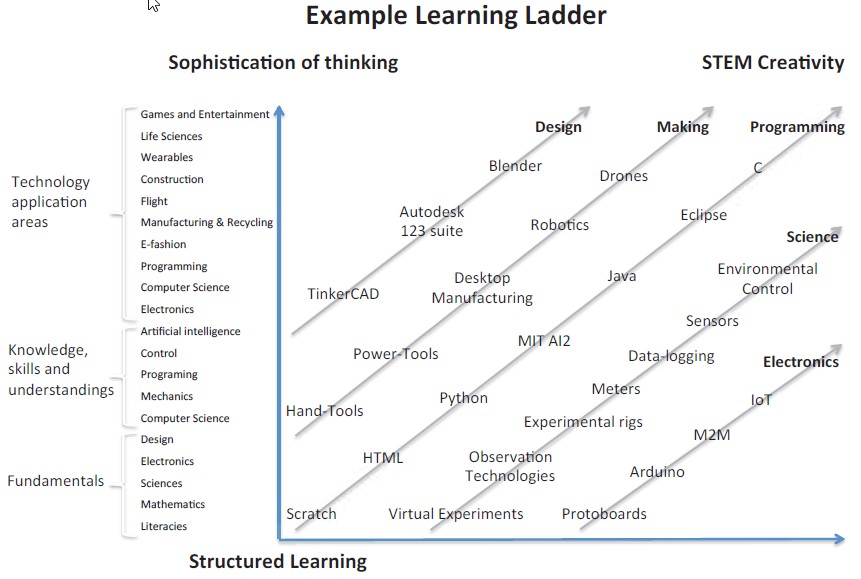
From his experience Luke believes that the BeeBots, Robot Mouse and Dash-and-Dot robots show the most promise for the long term and are applicable across a wide range of year levels. His intent initially with the younger children is to get them to play and engage with robots and the fundamentals of coding so they can begin with Scratch and Makey Makey as they get into Grade 3 and beyond. We had a good discussion at the time about the importance to not get hooked with the shiny toy thing (which is quite easy to do) and to have a structured approach that begins with the kids playing and then developing the aspects required by the Technologies curriculum. This is why the Learning Ladder approach, which we mentioned in a previous newsletter, is an important next step.
Planning for the Technologies Curriculum
We also had a great discussion at the workshop session about supporting teachers to plan units that can address the STEM, Coding, and whole Technologies curriculum. Since schools are mandated to deliver the Technologies curriculum from next year there seems to be a lot of consternation in schools about how they are going to do it. One of the big issues that came up is how schools perceive the Technologies Curriculum as an add-on to what they are doing and how many schools are tacking on yet another thing into their curriculum.
We cannot say this more strongly – if your school is going down that path – not only will it not work or be sustainable, you will be doing your students a huge injustice and not preparing them for the world they are growing into.
Technology is disrupting career pathways as well as society. To address the Technologies curriculum with any respect will need it to be infused into the way that curriculum is planned and delivered. Anything else means the school is treating it as a fad. Teachers want to know HOW to actually infuse it into their learning.
Given this demand from the teachers we have worked with we have designed a two day workshop to be run during October and November when Mike Lloyd from CLWB.org is back in Australia. In the workshop participants will not only be taken through a step by step process to plan STEM and Coding units based on the Technologies Curricula but will also participate and experience a range of practical STEM / Coding activities that can be run at your school. The outcome of the workshop is at least one STEM unit that you can use immediately at your school.
The first day will be experiential where participants will experience hands-on STEM and Coding activities that can be run at various year levels. Day two will be the guided planning day. We will be running separate Primary and Secondary level workshops so we can address the specific requirements of the attending schools.
What we are looking for is a quick email from you expressing interest to attend (or send someone), or to host the workshop. We are wanting to run the workshop in Brisbane, Ipswich, Townsville, Melbourne, Country Victoria, Adelaide and Perth. If you are interested, or want to express your interest, email me at adrian@intuyuconsulting.com.au
Raspberry Pi3
Finally, I will be visiting HumpyBong PS on the Redcliffe peninsula (Brisbane) in the coming weeks to find out how they use Raspberry Pi’s with their students. Keep an eye out for that video!
In the meantime I have found a great video from Geek Life with their Top 10 Coolest ideas on using the Raspberry Pi
We are offering sourced the latest Raspberry Pi3 computer with inbuilt Wi-Fi, Bluetooth, and CLWB Offline Coding SD Card (which has a specially design interface plus software and instructions for taking learners from Beginning Scratch through to programming in Python) for $209.90. If you would like to find out more and see the full price list (including discounts for bulk orders) email Rachel at office@intuyuconsulting.com.au

You may have noticed, along with our Bespoke In-School Professional Learning, that we have been running Introductory STEAM and Coding workshops in schools around Australia now for the past year. It is a fun and joyful experience as we see the teachers have their “ah-ha” moments! They experience that moment of insight:
“Oh! Coding isn’t as hard as I thought! “
“Wow! I can see how I can start to infuse the technologies curriculum into my classes”
“I wish some of the other teachers from my school had come so they can see that they can do it too!”
One of the questions we often get asked is what technology should we buy for our school?
Now there is a lot of technology out there from Lego Mindstorms, Spheros, 3D Printers and so on. Out first recommendation is that before you buy any technology or software you create a Learning Ladder. We talk about this in our workshops but unless you have created a simple map of the flow of learning / software / hardware in the areas identified in the Technologies curriculum you are likely to be spending money on technology or software that won’t meet the long term needs of your school. The image below is an example of one that Mike Lloyd, the international STEM expert from CLWB.org, has suggested as an example.
Having said all that one of the key pieces of technology we are recommending that all schools have in their suite of technology is the Raspberry Pi.
The Raspberry Pi is a powerful but cheap computer that is the size of a credit card that has an extraordinary rich range of resources and educational materials for teachers and students. You can check out what it is and some of its uses here (https://www.raspberrypi.org/help/what-is-a-raspberry-pi/ ).
But it isn’t just a small computer.

It has a series of GPIO pins (to the right of the CLWB SD Card in the image above) that allows you to connect the Raspberry Pi to electrical circuits and other technology so that users can implement a spectacular range of projects. Some examples (with lesson plans) include:
- Sensing the Weather: https://www.raspberrypi.org/learning/sensing-the-weather/
- Visual Sorting with Python: https://www.raspberrypi.org/learning/visualising-sorting-with-python/
- Sensing Space: https://www.raspberrypi.org/learning/sensing-space/
- Networking Lessons: https://www.raspberrypi.org/learning/networking-lessons/
- Sonic Pi Lessons: https://www.raspberrypi.org/learning/sonic-pi-lessons/
- Coder HTML CSS Lessons: https://www.raspberrypi.org/learning/coder-html-css-lessons/
and much, much more.
We have been playing around with it for a little while (as have our kids) and we can see the potential of the Raspberry Pi for shifting our technology consumption mindset to one of creativity and designing interesting STEM projects.
As a short term offer we have sourced the latest Raspberry Pi3 computer with inbuilt Wi-Fi, Bluetooth, and CLWB Offline Coding SD Card (which has a specially designed interface plus software and instructions for taking learners from Beginning Scratch through to programming in Python) for $209.90.
If you buy a set before the end of Term 3 we will also send you some of the materials Mike Lloyd and others have been developing around the Raspberry Pi that you can implement those projects immediately into your classes, Coding and/or Maker clubs.
Over the next few months we will be visiting schools who are already using the Raspberry Pi and sharing some of their ideas and resources.
If you would like to find out more and see the full price list (including discounts for bulk orders) email Rachel at office@intuyuconsulting.com.au or fill in the form!
[SlideDeck id=’227′ width=’100%’ height=’330px’]In Step 1 Designing Middle Leader Vision Statements we explored the first element of how middle leaders can plan to lead their team effectively. Once the middle leader has, in partnership with their team, created an inspiring but simple vision statement for their team, the next step is to create a Case for Action.
In modern schools change is always occurring. Whether it is pedagogical, curricula, well-being, or any other area, there is change occurring. It is a constant feature of our education system. One of the core roles of Middle Leaders is to lead this change. They work with their team of teachers to enact the requested change. Unless the teachers and middle leaders are connected to WHY this change is occurring and have bought into it then the change is not likely to occur with any depth or sustainability.
Middle leaders can establish a sense of urgency through a Case for Action Narrative. This narrative
- aims for the heart (not only the head)
- is driven by a belief in a noble vision or goal
- inspires determination to act and win now
The case for action addresses the need for change and paints a realistic, convincing and attractive picture of what the future could look like when the vision is realised. It highlights the difference it would make to tackle the desired area and also the ineffectiveness of not taking action.
Designing Case for Action Narratives
There are three parts to a Case for Action narrative:
- Describe the reality in the area – the things that are working, the challenges, and the gaps
- Describe the predictable future if no action was taken in this area
- Describe what could be possible if action, based on the vision, was taken
Part 1
The case for action begins with identifying the current reality in the area. You can flesh out the picture of the current reality by answering questions such as:
- What are the aspects of the area that are working?
- What are the aspects that are not currently working?
- What are the current gaps or challenges in the area?
- What are the effects on students, teachers and the school of this current reality?
Don’t pull any punches as you answer the above questions. Make sure you identify both the great things as well as the challenges. The intent is to create an authentic picture of how things are now in the area. You could also use actual data to prove your points. Remember though that the purpose of the first part of the Case for Action is to highlight the current reality.
Part 2
The second part of a case for action narrative describes the predictable future if no action was taken. This paints a vivid picture of why staying with the status quo is a problem. If we are going to create urgency then the case for action narrative needs to show that action is critical NOW.
When brainstorming what to write for this part imagine what the PREDICTABLE future would be. Mostly it is more of the same. You will continue to operate as you have always done and you will continue to have the same results and challenges. In an ever-changing world this is a big problem not only for schools but also for parents and students. Education is increasingly a competitive market and staying stationary is no longer an option if the school is going to survive. Parents and their children are more likely to leave a school if their child’s needs are not being met.
By continuing to do the same thing with the same results has an impact on students, teachers and the school over time – what could that be? Your description should paint a compelling picture that aims for the heart.
Part 3
The final part of a case for action narrative describes what would be possible if action was taken. The actions that would be taken would be aligned with the vision statement created previously. What would be the impact on students, teachers, learning, the school culture, and the long term future of the school? Again create a compelling and vivid picture. Describe it in such a way that when people hear what is possible they want to be part of that vision. It should draw them in and inspire or breathe life into them. When people hear what is possible they can see how they can contribute to having it happen. It compels action.
Examples of Case for Action Narratives
Mathematics
- Currently in Maths
- The teachers are streaming children for maths to some extent. They have been doing point of need teaching via a clustering approach but are now expected to move to handle various abilities in the one class
- Teachers don’t feel as if they are doing justice for the kids. The capable kids needs are not being met nor those who struggle with Maths
- The year 6 team is struggling with the rationale from the Year Level Coordinator in moving to the PYP approach which is requiring Numeracy be tied into the everyday classrooms
- Some students feel they are not good at maths and give up
- If no action is taken then predictably
- The situation in Maths classes won’t change
- Teachers will feel they aren’t doing a good job
- Students will develop a fixed mindset about their ability in Maths
- Maths results will stagnate or go backward
- If we acted on systemically differentiating maths for all ability groups then:
- Students will see the value of Maths
- Teachers would feel more confident that they are reaching the upper and lower group of students
- Student results would improve
- Classes would be more engaging for students
- Student learning confidence and competence would improve
Religion
- Currently in religious studies
- certain topic, areas and biblical stories are re-hashed each year
- due to external pressures on the school it seems like religious studies is the first to go when the curriculum needs to be covered
- Christian ethos is present but not authentic religious studies. It deserves to be taught / learnt well since we are a religious school
- Some teachers appear to be doing well
- Most of the teachers are accredited to deliver religious studies
- I have been sending out emails asking if teachers need any support but not getting much response
- The overall scope and sequence has been developed for religious studies
- If no action is taken then predictably
- Religious studies will continue to be sidelined and not valued
- There is a danger the school could become a secular school in practicality and lose its point of difference
- Teachers will do whatever they want to do without oversight
- Students will become bored with doing the same topics every year
- If we acted on the vision of guiding young people with small steps and successes so they grow profoundly as learners and realise their potential in the area of their religious studies then:
- Students will see the value of religious studies in their lives
- Students would be engaged in the classes and in exploring their spirituality because it matters to them
- They will see how they can use what they have learnt and explored in religious studies in making life decisions and contributing to others
- We would be designing engaging curriculum that authentically addresses issues pertinent to the students.
- The school would value religious studies and that it is a powerful point of difference for parents and potential students.
School Culture
- Currently in the junior school
- Quite a negative environment amongst the staff
- There appears to be a lot of clique groups. The general perception is that the “in clique” are treated differently
- Some staff experience being in the outer and can feel isolated and alone
- Ran a Relationship Building session at the start of the year and held 2 workshops over the pupil free days. During Term 1 did lot of stuff to show that I valued the staff and this was received well.
- Some original “clique” teachers experienced being burnt and now starting to turn to me
- Lot of people genuinely happy to have a voice now from what I have been doing
- If no action is taken then predictably
- The negative environment will continue and some staff will continue to feel isolated, alone and on the outer. They will then go through the motions in working in the school rather than being innovative or creative.
- Over time some staff will leave because they aren’t being valued and appreciated since they aren’t part of the clique group
- If we acted to have staff realise the power of positive relationships in empowering learning and leadership then
- Processes and protocols would be established that would lead to a positive environment
- Staff would feel valued and appreciated
- Staff would feel heard and that they have a voice
- Learning would improve within the school because people would be willing to innovate and be creative
- A positive work environment would arise
- People will want to work harder and contribute to the learning community because they are fulfilled by being part of the community.
Context for doing this
In John Kotter’s 8-step process for leading change he identifies that the first step in leading change is to convince others of the importance of acting immediately. He points out that “Leaders may underestimate how hard it is to drive people out of their comfort zones, or overestimate how successfully they have already done so, or simply lack the patience necessary to develop appropriate urgency”. School structures are inherently resistant to change as they, in many ways, rely on consistency and the status quo to be successful.
One of the greatest enemies to developing great schools is being good (e.g. “we are doing a good job”, “we are a good school”, “I am a good teacher”). Being “good” is a conversation from the comfort zone. Greatness requires constantly examining where one is against your goals working to having your vision become reality. Over time “good” tends to devolve into “good enough” and then mediocrity.
If people are to be compelled and encouraged into urgent action then they need to know WHY. They need to know the criticality of taking action now. Kotter pointed out that usually the urge is to skip to the doing rather than spend the required time it takes to get a significant number of team members urgent. This is not about getting people to work harder or be busier it is about getting people clearly focused on making real progress towards the vision every single day. Leaders who know what they are doing will “aim for the heart.” They will connect to the deepest values of their people and inspire them to greatness. They will make the case for action come alive with human experience, engage the senses, create messages that are simple and imaginative, and call people to aspire. The case for action narrative is the first step to creating urgency.
References
- Leading Change, John P. Kotter, Harvard (2012)
- Review of contemporary research on middle and teacher leaders, Dr Maureen O’Rourke and Dr Peter Burrows, Bastow Institute of Educational Leadership (2013)
- Extraordinary Leadership in Australia & New Zealand: The five practices that create great workplaces, James Kouzes and Barry Posner with Michael Bunting, Wiley (2014)
- Hardwired Humans: Successful Leadership Using Human Instincts, Andrew O’Keeffe, Roundtable Press (2012)
Posted in Training |
Tags: case for action, change, middle leaders, narrative, urgency |
No Comments »